
Wireless Smartphone Battery Sharing: Reimagining the Future of Mobile Power Transfer
Explore the future of wireless smartphone battery sharing and innovative mobile power transfer technologies.
Technology Researcher
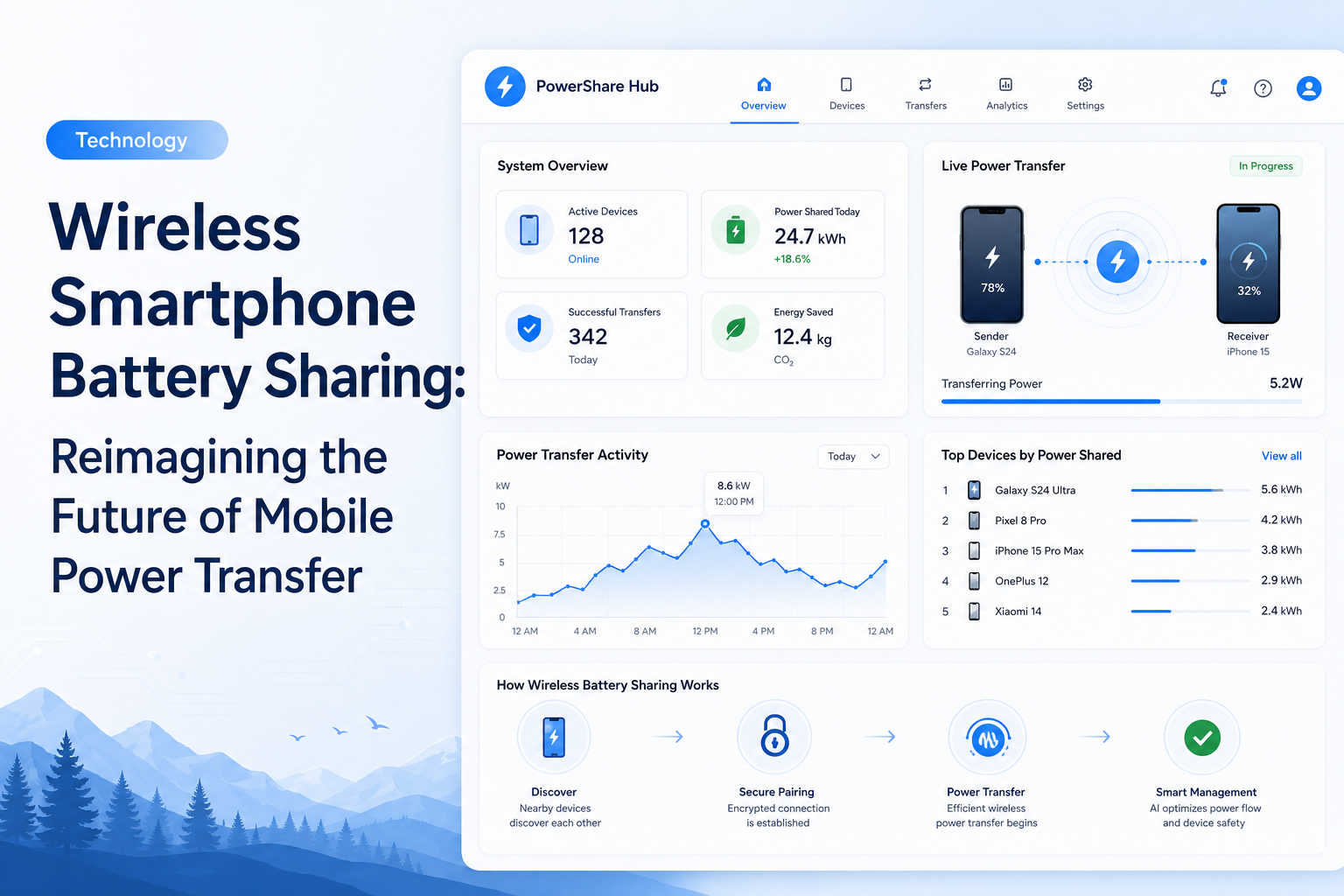
Abstract
Over the last decade, smartphones have become an essential part of human life. People rely on mobile devices not only for communication but also for banking, education, entertainment, navigation, business operations, and emergency situations. As smartphone capabilities continue to improve, battery consumption has increased significantly, creating one common problem faced by nearly every user — running out of battery at unexpected moments.
Today, smartphones can easily share internet connectivity through Wi-Fi hotspot technology, exchange files through Bluetooth, and synchronize data through cloud-based systems. However, while digital information can move freely between devices, battery power remains limited to individual devices and cannot be directly shared whenever another device requires immediate energy support.
This creates an opportunity for future innovation.
This article introduces the concept of Wireless Smartphone Battery Sharing, a technology that allows one smartphone to transfer part of its stored battery power directly to another nearby smartphone without requiring charging cables, adapters, or external power banks.
The primary objective of this concept is to create a smarter mobile ecosystem where devices can support one another during low battery situations. By enabling direct energy transfer between smartphones, future devices can become more collaborative, reduce dependence on charging accessories, and offer practical solutions during emergency situations.
This innovation has the potential to redefine how mobile devices manage and distribute portable energy in the future.
Solution
The proposed solution focuses on building a device-to-device wireless energy transfer system integrated directly inside smartphones.
The idea originates from a simple observation. Modern smartphones already allow users to share resources such as internet connectivity and files. If digital resources can be transferred from one device to another, future smartphones can also be designed to transfer electrical energy.
The system works by combining wireless charging technology with intelligent battery management systems.
Inside every compatible smartphone, an advanced bi-directional wireless transmission module would be installed. Existing wireless charging technology allows phones to receive power from external charging pads. In this proposed system, smartphones become capable of both receiving and sending electrical energy.
When battery sharing mode is activated, the smartphone temporarily behaves as a wireless charging source.
The second major component is an Energy Management Controller, responsible for controlling how much battery power can safely leave the device.
Unlike traditional charging systems where maximum speed is prioritized, battery sharing requires controlled and gradual transfer to protect battery health.
A dedicated mobile interface would allow users to choose how much battery energy they want to share.
The system may provide options such as:
- Emergency Power Mode for urgent battery support
- Manual Transfer Mode where users choose battery percentage
- Smart Transfer Mode where artificial intelligence determines safe transfer limits automatically
The system also requires advanced safety mechanisms.
Internal sensors continuously monitor important conditions including:
- Battery temperature
- Voltage fluctuations
- Hardware stress levels
- Charging efficiency
- Battery discharge rate
If unsafe conditions occur, the system automatically pauses transfer to prevent hardware damage.
Another important consideration is battery protection.
If a user has 40% battery remaining, the phone should not transfer more energy than safe operating conditions allow. A minimum battery threshold ensures the sender device does not lose essential power.
This entire system creates a secure and intelligent environment where smartphones can function as temporary portable energy sources for one another.
Step-by-Step Guide
The following process explains how wireless battery sharing could work in real-world usage.
Step 1 – Activate Battery Sharing Mode
The user opens device settings and selects a new feature called Battery Sharing Mode. Once enabled, the smartphone prepares itself to transmit battery power to nearby compatible devices. This mode temporarily converts the device into an energy provider.
Step 2 – Detect Nearby Compatible Devices
After activation, the smartphone scans nearby devices using short-range wireless communication technology. The system searches for smartphones that support battery sharing technology.
Nearby compatible devices appear on screen:
- Device A available
- Device B available
- Device C available
The user selects the target device.
Step 3 – Secure Authentication Process
Before transferring energy, both devices establish a secure connection. The receiving device sends a confirmation request asking permission to receive battery power.
Authentication checks verify:
- Device compatibility
- Operating system support
- Security approval
- Battery condition
This step prevents unauthorized battery access.
Step 4 – Select Transfer Amount
The sender chooses how much battery energy should be transferred.
Possible options include:
- 5% battery transfer
- 10% battery transfer
- Emergency support mode
- Automatic AI-based transfer
The system calculates whether safe transfer conditions exist.
Step 5 – Device Positioning
Both smartphones are placed close together. Internal wireless transmission coils automatically align to create an efficient transfer pathway. Signal strength detection confirms optimal positioning.
Proper alignment improves transfer efficiency and reduces power loss.
Step 6 – Start Energy Transfer
Once connection and alignment are confirmed, battery transfer begins automatically. The sender phone gradually transmits electrical energy to the receiving phone.
A live interface displays:
- Battery percentage transferred
- Current transfer speed
- Estimated completion time
- Device temperature condition
The transfer speed remains controlled to protect internal battery health.
Step 7 – Intelligent Monitoring System
During the transfer process, multiple internal monitoring systems remain active.
The smartphone continuously checks:
- Internal battery temperature
- Voltage stability
- Battery discharge rate
- Energy transfer efficiency
- Receiver battery condition
If overheating or abnormal battery stress occurs, transfer speed automatically reduces. In severe conditions, the system pauses immediately.
Step 8 – Automatic Completion
The process automatically stops once predefined conditions are met.
Transfer ends when:
- The selected battery percentage is successfully transferred
- The sender battery reaches minimum safety threshold
- Temperature exceeds safe operating limits
- The user manually stops transfer
A final summary screen shows the amount of energy transferred successfully.
Conclusion
Wireless Smartphone Battery Sharing introduces a completely new direction for future mobile technology.
For years, smartphones have focused on communication and digital interaction. Users can already share internet connectivity, files, multimedia content, cloud data, and digital services between devices almost instantly. The next stage of mobile evolution could allow devices to exchange something even more valuable — electrical energy.
This technology has the potential to solve one of the most common and frustrating smartphone problems faced by users worldwide: sudden battery drain during situations where charging options are unavailable.
The concept creates significant advantages by allowing devices to support one another whenever emergency battery access is required.
Pros
The technology offers several important benefits.
- Eliminates dependency on carrying power banks in many situations
- Provides immediate battery support during emergencies
- Improves convenience for travelers and remote users
- Creates a collaborative smartphone ecosystem
- Reduces dependency on charging stations
- Supports future interconnected smart device environments
At the same time, several engineering challenges must be addressed before practical implementation becomes commercially possible.
Cons
Certain limitations currently exist.
- Wireless transfer naturally causes some energy loss
- Continuous transfer may generate internal heat
- Long-term battery health could be affected by frequent sharing
- Older smartphones may not support advanced hardware requirements
- Security systems must prevent unauthorized battery usage
Despite these challenges, future developments in wireless charging technology, battery engineering, and artificial intelligence can make this concept a realistic possibility.
In the future, smartphones may no longer function only as communication devices. They may evolve into intelligent portable energy-sharing systems capable of supporting nearby devices whenever power is needed.
This innovation represents an important step toward building a smarter and more connected technological future.