
Salesforce Testing Basics for QA Engineers
Master the fundamentals of Salesforce testing, including functional, regression, integration, and user acceptance testing.
QA Engineer
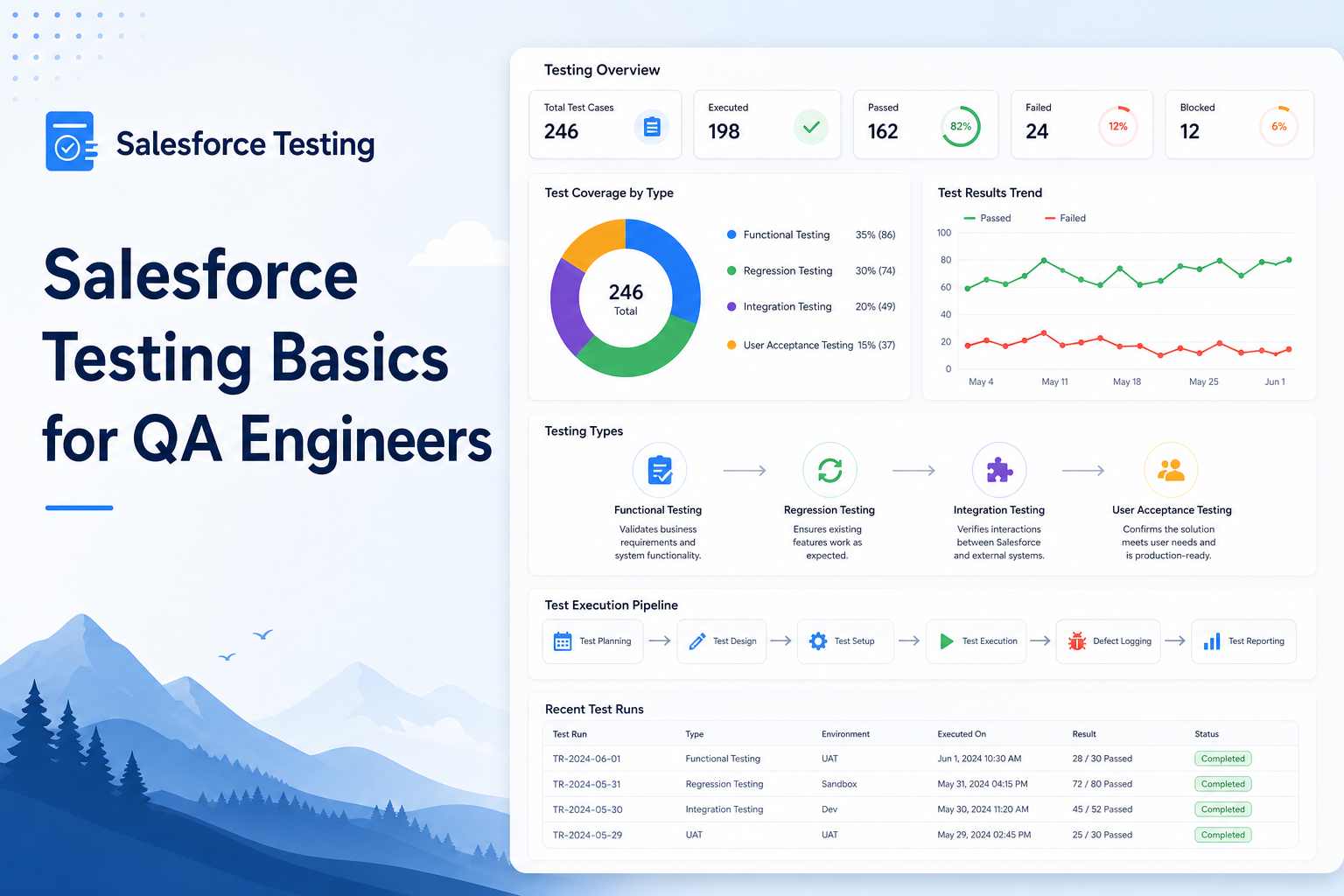
Abstract
Salesforce testing plays a critical role in ensuring the quality, reliability, and performance of applications built on the Salesforce platform. The objective of Salesforce testing is to verify that business requirements are implemented correctly and that the application functions as expected. This article introduces the basic concepts of Salesforce testing and explains the different types of testing commonly performed by QA engineers.
Solution
Salesforce applications consist of standard objects, custom objects, validation rules, workflows, flows, Apex classes, Lightning Web Components, and integrations. QA engineers are responsible for validating these components to ensure that the system behaves correctly under different scenarios.
Testing in Salesforce involves verifying data integrity, user permissions, business logic, automation processes, and user interface functionality. Proper testing helps identify defects early and improves overall application quality.
Key Areas of Salesforce Testing
- Functional Testing
- User Interface Testing
- Validation Rule Testing
- Profile and Permission Testing
- Workflow and Flow Testing
- Integration Testing
- Regression Testing
- User Acceptance Testing (UAT)
Step-by-Step Guide
Step 1: Understand Business Requirements
- Review requirement documents and user stories.
- Identify the expected behavior of the application.
- Prepare test scenarios and test cases.
Step 2: Verify Data and Objects
- Validate standard and custom objects.
- Check field-level requirements.
- Verify page layouts and related lists.
- Ensure mandatory fields are working correctly.
Step 3: Test Validation Rules
- Enter invalid data.
- Verify that appropriate error messages are displayed.
- Confirm that valid records are saved successfully.
Step 4: Test Profiles and Permissions
- Log in with different user profiles.
- Verify object permissions.
- Check field-level security.
- Ensure users can access only authorized records and features.
Step 5: Test Automation
- Create or update records.
- Verify Workflow Rules and Flows.
- Confirm email alerts and field updates.
- Ensure automated processes execute successfully.
Step 6: Test Lightning Web Components
- Verify component visibility.
- Validate user input.
- Check button actions and navigation.
- Ensure data is displayed correctly.
Step 7: Perform Integration Testing
- Validate API requests and responses.
- Test data synchronization with external systems.
- Verify error handling mechanisms.
Step 8: Execute Regression Testing
- Retest existing functionality after changes.
- Ensure previously working features are not affected.
- Document defects and retest after fixes.
Common Testing Types in Salesforce
Functional Testing
Ensures that the application performs according to business requirements.
System Testing
Validates the complete end-to-end functionality of the application.
Regression Testing
Ensures that new changes do not impact existing functionality.
Integration Testing
Verifies communication between Salesforce and external applications.
User Acceptance Testing (UAT)
Confirms that the solution meets business expectations.
Conclusion
Salesforce testing is essential for delivering reliable and high-quality applications. QA engineers must understand business requirements and perform various types of testing to ensure that the system behaves correctly. Effective testing reduces defects, improves user satisfaction, and contributes to successful Salesforce implementations.
Advantages
- Improves application quality.
- Identifies defects early.
- Ensures business requirements are met.
- Enhances system reliability.
- Reduces production issues.
- Improves user experience.
Disadvantages
- Requires thorough understanding of business processes.
- Regression testing can be time-consuming.
- Complex integrations require additional testing effort.
- Test data preparation may be challenging.
Technologies and Tools Used
- Salesforce Platform
- Lightning Experience
- Flows and Workflow Rules
- Developer Console
- Data Loader
- Postman
- Jira
- Test Case Documents
Summary
Salesforce testing is a fundamental responsibility of QA engineers. Understanding different testing types and following structured testing practices helps ensure that Salesforce applications are reliable, secure, and aligned with business requirements. A strong testing process ultimately contributes to successful project delivery and improved customer satisfaction.