
REST API Testing Guide for QA Engineers
A complete guide for QA engineers to validate REST APIs using industry-standard testing techniques and tools.
QA Engineer
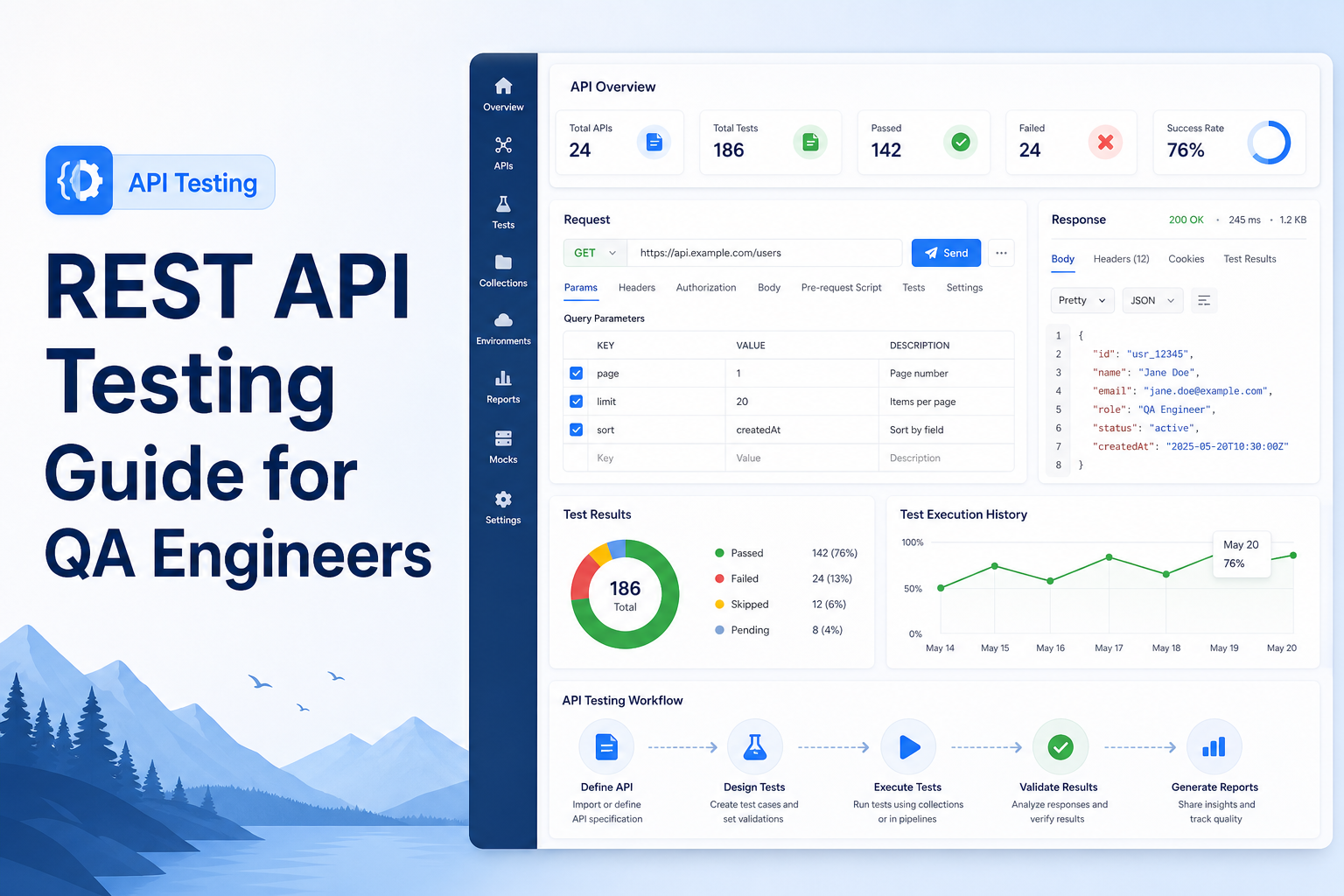
Abstract
REST APIs play a crucial role in modern applications by enabling communication between different systems, services, and platforms. As businesses increasingly rely on APIs for data exchange and functionality, ensuring their reliability, security, and performance is essential. API testing helps Quality Assurance (QA) engineers validate that APIs behave as expected, process requests correctly, return accurate responses, and handle errors effectively. This guide provides an overview of REST API testing and outlines a structured approach for validating API functionality and quality.
Solution
REST API testing focuses on verifying the behavior of an API independently of the user interface. By directly testing the API layer, QA engineers can identify defects early in the development cycle and ensure that business logic, data processing, and integrations function correctly.
A comprehensive API testing strategy should validate endpoint accessibility, request and response structures, authentication mechanisms, error handling, data integrity, security controls, and performance. Thorough testing helps improve application stability, reduce defects, and support successful integrations between systems.
Step-by-Step Guide
Step 1: Understand the API Requirements
Begin by reviewing the API documentation to understand its functionality, available endpoints, supported HTTP methods, request parameters, authentication requirements, and expected responses. A clear understanding of the API specifications helps create accurate test scenarios.
Step 2: Validate Endpoint Accessibility
Verify that the API endpoints are accessible and respond correctly to requests. Ensure that the endpoint URLs are accurate and that the API is available in the target environment.
Step 3: Verify HTTP Methods
Test the supported HTTP methods such as GET, POST, PUT, PATCH, and DELETE. Confirm that each method performs the intended operation and returns the appropriate response.
Step 4: Validate Response Codes
Ensure that the API returns the correct HTTP status codes for various scenarios. Successful requests, invalid inputs, authentication failures, and server errors should all return appropriate response codes that align with API standards.
Step 5: Verify Response Data
Validate the response body to ensure that the returned data is accurate, complete, and formatted correctly. Check field names, data types, mandatory attributes, and business logic requirements.
Step 6: Test Request Parameters and Inputs
Verify how the API handles different input values, including valid data, invalid data, missing parameters, and boundary conditions. This helps confirm that the API processes requests reliably and consistently.
Step 7: Validate Authentication and Authorization
Test the API's security mechanisms to ensure that only authorized users can access protected resources. Verify that authentication tokens, API keys, or other security controls function as expected.
Step 8: Perform Negative Testing
Execute scenarios involving invalid requests, incorrect data formats, missing required fields, and unauthorized access attempts. Confirm that the API handles these situations gracefully and returns meaningful error messages.
Step 9: Verify Data Integrity
Ensure that API operations correctly create, update, retrieve, or delete data as intended. Validate that the information stored in the system remains accurate and consistent after API transactions.
Step 10: Conduct Performance Testing
Evaluate the API's performance under different workloads. Verify response times, stability, and scalability when processing multiple requests or large volumes of data.
Step 11: Perform Security Testing
Assess the API for potential security vulnerabilities. Verify that sensitive information is protected, access controls are enforced, and the API is resilient against common security threats.
Step 12: Automate API Tests
Automate frequently executed test scenarios to improve efficiency and support continuous testing. Automated API tests help ensure consistent validation across multiple releases and environments.
Conclusion
REST API testing is a critical component of modern software quality assurance. By validating functionality, security, performance, and data integrity at the API layer, QA engineers can identify issues early and help deliver reliable applications. A structured API testing approach improves software quality, supports seamless integrations, and contributes to a more stable and scalable system.
Pros
- Detects issues early in the development lifecycle.
- Faster and more reliable than UI-based testing.
- Improves application stability and integration quality.
- Supports efficient test automation.
- Validates business logic and data processing effectively.
Cons
- Requires knowledge of API protocols and concepts.
- Authentication and security testing can be complex.
- May require access to backend systems for validation.
- Performance and security testing often require specialized tools.
Implementing effective REST API testing practices enables QA teams to deliver high-quality applications while ensuring reliable communication between systems and services.