
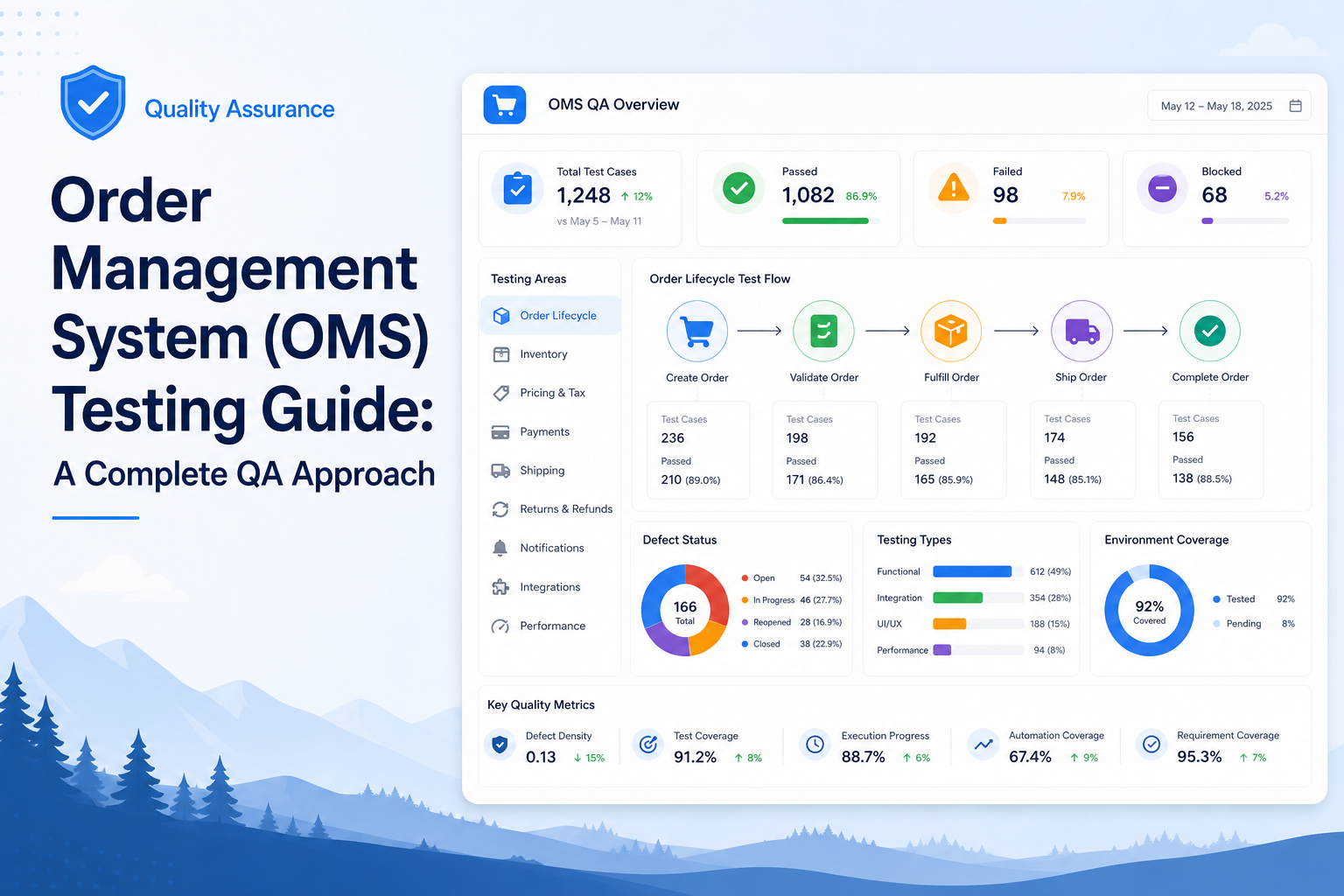
Order Management System (OMS) Testing Guide: A Complete QA Approach
Comprehensive QA testing strategies for validating Order Management Systems from end to end.
QA Engineer
Introduction
An Order Management System (OMS) is a critical component of any e-commerce or retail business. It manages the complete order lifecycle, from order placement to fulfillment, shipping, delivery, returns, and refunds.
Since OMS directly impacts customer satisfaction and business operations, thorough testing is essential to ensure orders are processed accurately and efficiently.
This guide covers the key areas, test scenarios, and best practices for OMS testing.
What is an Order Management System (OMS)?
An OMS is a software application that helps businesses manage customer orders across multiple sales channels.
Key Functions of OMS
- Order Creation
- Order Processing
- Inventory Management
- Fulfillment Management
- Shipping and Tracking
- Returns and Refunds
- Customer Notifications
Why OMS Testing is Important
A defect in the order management process can lead to:
- Incorrect order fulfillment
- Inventory mismatches
- Shipping delays
- Payment issues
- Customer dissatisfaction
- Revenue loss
OMS testing helps ensure that every order is processed accurately throughout its lifecycle.
Order Lifecycle in OMS
A typical OMS process includes:
- Customer Places an Order
- Order Validation
- Payment Authorization
- Inventory Reservation
- Order Fulfillment
- Shipment Creation
- Tracking Information Update
- Order Delivery
- Returns or Refunds (if applicable)
QA engineers should validate each stage of this workflow.
Key OMS Testing Areas
1. Order Creation Testing
Verify that orders are created successfully.
Test Scenarios:
- Place orders as Guest Users.
- Place orders as Registered Users.
- Verify unique order number generation.
- Validate customer information.
- Verify order confirmation messages.
2. Payment Validation Testing
Ensure payment processing works correctly.
Test Scenarios:
- Successful payment transactions.
- Failed payment transactions.
- Expired card validation.
- Invalid payment details.
- Partial payment scenarios.
- Payment gateway timeout handling.
3. Inventory Management Testing
Verify inventory is updated correctly.
Test Scenarios:
- Stock reduction after order placement.
- Inventory reservation validation.
- Out-of-stock product handling.
- Backorder processing.
- Inventory synchronization across systems.
4. Order Fulfillment Testing
Ensure orders move correctly through fulfillment stages.
Test Scenarios:
- Order status updates.
- Fulfillment center assignment.
- Split shipment validation.
- Multiple item order processing.
- Fulfillment exception handling.
5. Shipping and Tracking Testing
Verify shipping information and tracking updates.
Test Scenarios:
- Shipment creation.
- Tracking number generation.
- Tracking status updates.
- Multiple shipment orders.
- Carrier integration validation.
6. Order Cancellation Testing
Ensure cancellation functionality works properly.
Test Scenarios:
- Cancel before fulfillment.
- Cancel after fulfillment.
- Partial order cancellation.
- Refund processing after cancellation.
- Inventory restoration validation.
7. Returns and Refunds Testing
Verify return and refund workflows.
Test Scenarios:
- Full return requests.
- Partial return requests.
- Refund calculation accuracy.
- Inventory update after return.
- Return approval workflow.
8. Customer Notification Testing
Customers should receive accurate updates.
Test Scenarios:
- Order confirmation emails.
- Shipping notification emails.
- Delivery confirmation emails.
- Cancellation notifications.
- Refund notifications.
9. Integration Testing
OMS typically integrates with multiple systems.
Test Scenarios:
- Payment Gateway Integration
- ERP Integration
- Warehouse Management System Integration
- CRM Integration
- Shipping Carrier Integration
Verify data consistency across all connected systems.
End-to-End OMS Testing Scenario
Example Workflow:
- Customer places an order.
- Payment is authorized.
- Inventory is reserved.
- OMS creates fulfillment request.
- Warehouse ships the order.
- Tracking number is generated.
- Customer receives shipment email.
- Order status changes to Delivered.
QA engineers should validate every step in this process.
Common OMS Defects
Some commonly identified defects include:
- Duplicate order creation
- Incorrect inventory updates
- Missing shipment tracking information
- Incorrect tax calculation
- Failed order status updates
- Payment authorization failures
- Missing customer notifications
- Refund calculation errors
OMS Testing Best Practices
Understand the Complete Order Flow
Study how orders move between OMS, payment systems, inventory systems, and fulfillment centers.
Perform End-to-End Testing
Validate complete customer journeys instead of isolated modules.
Test Real Business Scenarios
Use realistic order quantities, payment methods, and shipping options.
Focus on Integration Testing
Many OMS defects occur due to integration failures.
Validate Order Status Transitions
Ensure orders move correctly between statuses such as:
- Created
- Confirmed
- Fulfilled
- Shipped
- Delivered
- Cancelled
- Returned
Execute Regression Testing
Verify existing functionality after every release.
Test Exception Scenarios
Validate behavior during:
- Payment failures
- Inventory shortages
- Shipment delays
- Integration outages
Conclusion
An Order Management System is the backbone of modern e-commerce operations. Effective OMS testing ensures accurate order processing, inventory management, fulfillment, shipping, and customer communication.
By focusing on end-to-end workflows, integrations, and real-world business scenarios, QA engineers can significantly improve system reliability and deliver a seamless customer experience.
A well-tested OMS not only reduces operational issues but also helps businesses build customer trust and improve overall efficiency.