
Bus Tracking Application using Salesforce, Lightning Web Components, and Geolocation API
Develop a real-time bus tracking application using Salesforce, Lightning Web Components, and the Geolocation API.
Salesforce Developer
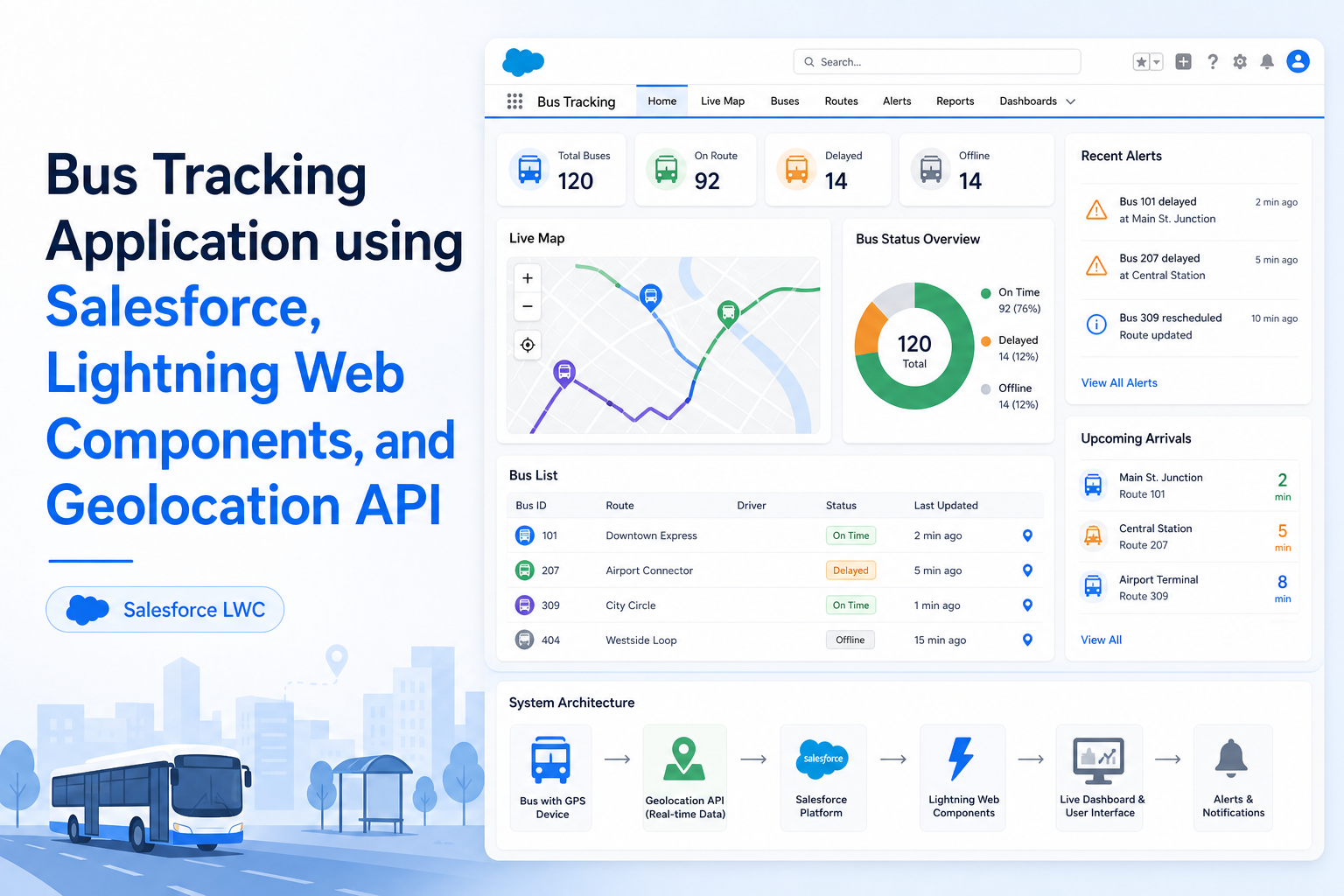
Abstract
The Bus Tracking Application is designed to provide real-time visibility into the location and status of buses. The objective of this application is to improve transportation management by allowing users to track buses, monitor their current locations, and estimate arrival times. The solution leverages Salesforce, Lightning Web Components (LWC), Apex, and Geolocation APIs to deliver an interactive and user-friendly tracking system.
Solution
The Bus Tracking Application enables administrators and users to monitor buses through a centralized interface. Bus information, including route details, driver information, and geographical coordinates, is stored in Salesforce records. The application uses Lightning Web Components to display bus information and Apex controllers to retrieve and update data.
The current location of a bus can be obtained through GPS devices or Geolocation APIs and updated periodically. Users can view the latest location and route information through the application.
Key Features
- Real-time bus location tracking.
- Route and destination management.
- Driver and vehicle information management.
- Interactive user interface using Lightning Web Components.
- Automatic location updates.
- Display of estimated arrival information.
- Centralized monitoring of multiple buses.
Step-by-Step Guide
Step 1: Create Custom Objects
Create a Bus object. Add fields such as:
- Bus Number
- Route Name
- Driver Name
- Current Latitude
- Current Longitude
- Status
Step 2: Create Apex Controller
- Develop an Apex class to retrieve bus records.
- Implement methods to update location information.
- Return bus details to Lightning Web Components.
Step 3: Create Lightning Web Components
- Create a component to display bus information.
- Add a search option to find buses by route or number.
- Display current status and location details.
- Refresh data periodically.
Step 4: Integrate Geolocation API
- Obtain GPS coordinates from the device or external source.
- Update latitude and longitude values.
- Store location information in Salesforce records.
- Retrieve and display the latest location.
Step 5: Deploy and Test
Sample Data:
| Bus Number | Route | Driver Name | Status |
|---|---|---|---|
| BUS-101 | City Center – Airport | John Smith | Running |
| BUS-202 | Railway Station – Mall | David Wilson | Delayed |
| BUS-303 | College – Bus Stand | Michael Brown | Running |
Step 6: Monitor Bus Information
- Search for a bus using its number.
- View the route and current status.
- Track the latest location.
- Monitor multiple buses simultaneously.
Architecture Flow
User Interface (LWC)
        ↓
  Apex Controller
        ↓
 Salesforce Database
        ↓
Geolocation API / GPS Device
        ↓
   Location Updates
        ↓
Real-Time Bus Tracking Information
Conclusion
The Bus Tracking Application provides an efficient solution for monitoring transportation services. By combining Salesforce, Apex, Lightning Web Components, and Geolocation APIs, organizations can improve operational efficiency and provide better visibility into bus movements.
Advantages
- Provides real-time bus location information.
- Improves transportation management.
- Enhances passenger convenience.
- Reduces uncertainty regarding arrival times.
- Supports centralized monitoring.
- User-friendly interface.
Disadvantages
- Requires internet connectivity.
- Depends on GPS accuracy.
- Frequent location updates may increase API usage.
- Additional hardware may be required for live tracking.
- Maintenance is needed for continuous monitoring.
Technologies Used
- Salesforce Platform
- Lightning Web Components (LWC)
- Apex
- JavaScript
- Geolocation API
- SOQL
- HTML and CSS
Summary
The Bus Tracking Application demonstrates how Salesforce can be used to build location-based solutions. By integrating Apex, Lightning Web Components, and Geolocation services, organizations can track buses in real time, improve operational efficiency, and provide a better experience for passengers.